We use cookies and similar technologies to help personalise content, tailor and measure ads, and provide a better experience. By clicking ‘Accept All’ or turning an option on in ‘Configure Settings’, you agree to this, as outlined in our Cookie Policy. To change preferences or withdraw consent, please configure your cookie settings.
Our Platform uses various types of cookies, each of which has a specific function. Below you can manage your preferences.
Technical Cookies
These cookies are essential to provide you with services available through this Platform and to use some of its features, such as access to secure areas. Without these cookies, services you have asked for, like transactional pages and secure login accounts, would not be possible.
Functionality Cookies
These cookies serve a variety of purposes related to the presentation, performance and functionality of this Platform. Their overall purpose, however, is to enhance visitors’ experience and enjoyment of this Platform. For example, some of these cookies enable visitors to specify language, product or other platform preferences.
Analytical Cookies
These cookies, including those from third parties, are used to collect information about how visitors use our Platform. The information gathered does not identify any individual visitor and is aggregated. It includes the number of visitors to our Platform, the platforms that referred them to our Platform and the pages that they visited on our Platform. We use this information to help run our Platform more efficiently, to gather broad demographic information and to monitor the level of activity on our Platform.
Advertising Cookies
These cookies, including those from third parties, are aimed at creating profiles related to you and are used to deliver adverts more relevant to you and your interests in line with your preferences expressed while surfing the web. They are also used to limit the number of times you see an advertisement as well as help to evaluate the effectiveness of advertising and promotion. They are usually placed by advertising networks with our permission. They remember that you have visited a platform and this information is shared with other organisations such as advertisers.
Social Cookies
These cookies are third party cookies (e.g. Facebook) that allow you to interact with social media platforms. The companies that serve these cookies may also use your information to serve targeted advertising on other platforms.
Third party cookies are cookies from sites or web servers other than our own, which are also used for the purposes of those third parties.
For more information about the cookies used on our site, their characteristics and how to manage your consent to their use, you can consult our Cookie Policy.
By clicking “Save and close” you declare that you consent to the use of cookies according to the above preferences.
By clicking "Accept all" you declare that you consent to the use of all cookies stated above.
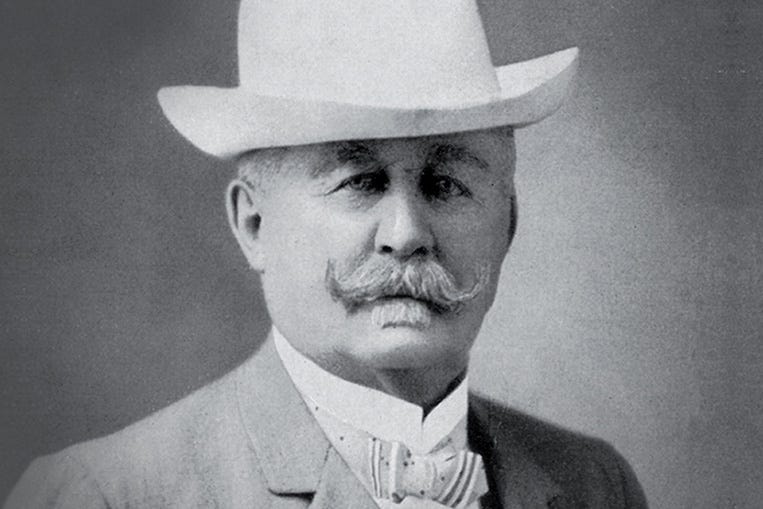
At 22, most people are still sitting on their parents’ sofa, dreaming about how they’re going to make their fortune. But it was at this tender age that enterprising young watchmaker Georges Favre-Jacot set up his own watchmaking company in Le Locle, a Swiss municipality nestled amidst the Jura Mountains. He had dreams of doing things a little differently.
At the time in 1865, it was common practice for watch companies to buy parts from subcontracted watchmaking professionals. Favre-Jacot brought these craftsmen together under one roof, so that all parts of the watches his company created—from movement to case—could be constructed synchronously and entirely in-house. Uniting all of the watch professions meant that the process was streamlined, ensuring that the components of each piece interacted with each other as smoothly as possible. Favre-Jacot had created the first ‘manufacture’ as we know them today.
Georges Favre-Jacot, who founded what would become Zenith at only 22 years old
The newfound company made a name for itself producing precision pocket watches, and launched its first pocket chronograph in 1899. Business was good, and soon the production was expanded to onboard instruments, table clocks, pendulum clocks and marine chronometers. The manufacture competed successfully in several Neuchâtel Observatory competitions, and its pieces were being sold across the globe thanks to the business acumen of Favre-Jacot’s nephew, James Favre.
Despite its success, the company didn’t officially take the name Zenith until 1911—a moniker that symbolised its founder’s quest to create timepieces at the very peak of quality. The manufacture became a stock company, and Favre-Jacot handed control of Zenith over to his nephew. Under James Favre’s direction, Zenith would grow to employ 1,000 people by 1925—and soon began producing wristwatches of the same excellent quality as its earlier pocket watches.
In 1948, Zenith watchmaker Ephrem Jobin created the iconic calibre 135—a wristwatch movement that incorporated a larger barrel and oversized balance to increase its precision. It went on to win literally hundreds of Observatory chronometer competitions, at one point winning five years in a row from 1950-1954.
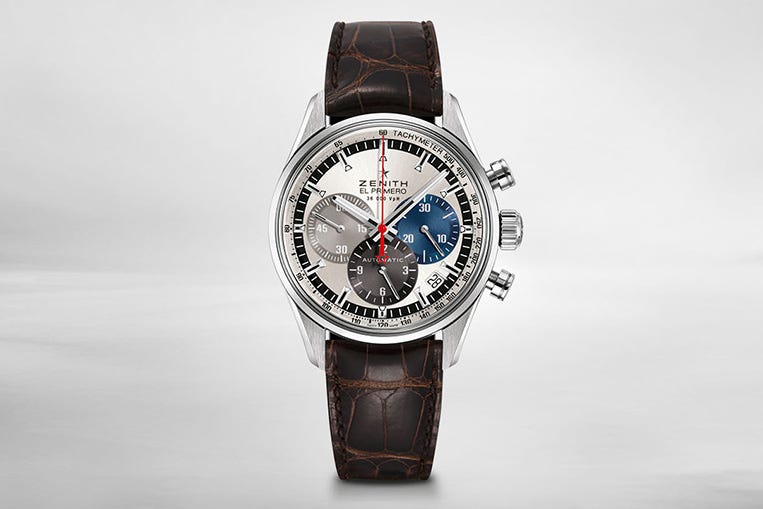
It was the events of 1969, though, that would ultimately become what the Zenith brand is so closely associated with. The race was on to build the first automatic chronograph, and Zenith was up against a power-house partnership between Heuer, Breitling, Hamilton-Buren, and Dubois Depraz. Both competing parties premiered an automatic chronograph movement that year—Heuer et al’s Caliber 11, and Zenith’s El Primero.
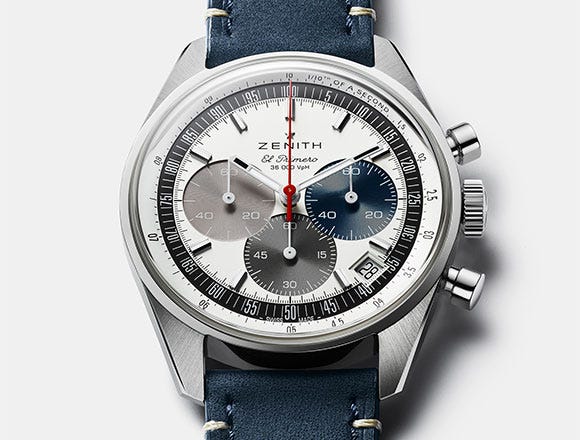
The iconic El Primero was the first fully-integrated automatic chronograph
Debate is rife as to who invented the very first automatic chronograph, but what is agreed on is that the El Primero was the first fully-integrated movement. Where the Caliber 11 was modular, Zenith’s offering was much more streamlined, boasting a far slimmer profile.
The El Primero was widely lauded as exceptional, and has since been used in various modified forms by several leading brands, including Rolex, Panerai—and even TAG Heuer. It was a turning point in Zenith’s history, but most importantly, it secured the legacy of outstanding watchmaking that Favre-Jacot had dreamed of establishing one hundred years earlier.
But it wasn’t all plain sailing for the prestigious movement. Production of the El Primero halted during the quartz crisis of the early 1970s and 1980s, when desire for mechanical watches dwindled thanks to the influx of much cheaper quartz technology. The Zenith Radio Corporation had bought the majority of Zenith shares, and in 1975, the order came down from on high to stop the manufacture of mechanical movements and destroy all plans and machinery used in the process.
Thankfully, watchmaker Charles Vermot had the foresight to hide parts, tools and manufacturing drawings in the attic of the manufacture. When demand for mechanical watches returned in the mid-80s, production of the El Primero—and ultimately other mechanical calibres—could begin once again. Zenith today is part of the LVMH luxury group, and continue to create superlative watches that are highly regarded by the watch community—just as Favre-Jacot had intended.